
It was Vijaya Dashami, yesterday.
For Indians, and especially Bengalis, this day holds a unique meaning. It marks the tenth and final day of Durga Puja, when we bid adieu to the Goddess. Naturally, many of us try to absorb a little more on this day, knowing that we must wait another year to relive these fleeting moments.
Dashami is also observed as a day of rededication. The preceding nine days are spent acknowledging our strengths and our shortcomings, recognising the many facets of our character. On the tenth day, the Visarjan symbolises compassion towards our weaker selves and the courage to let go of what no longer serves us, embracing life with renewed purpose. Someone elderly and priestly, who had seen many moons, once explained it to me this way.
But today, I want to write about something more tangible.
Yesterday, I witnessed one of the most graceful, yet heart-wrenching, Durga Visarjans I have ever seen: Shobha Bajar Rajbari – Chhoto Taraf.
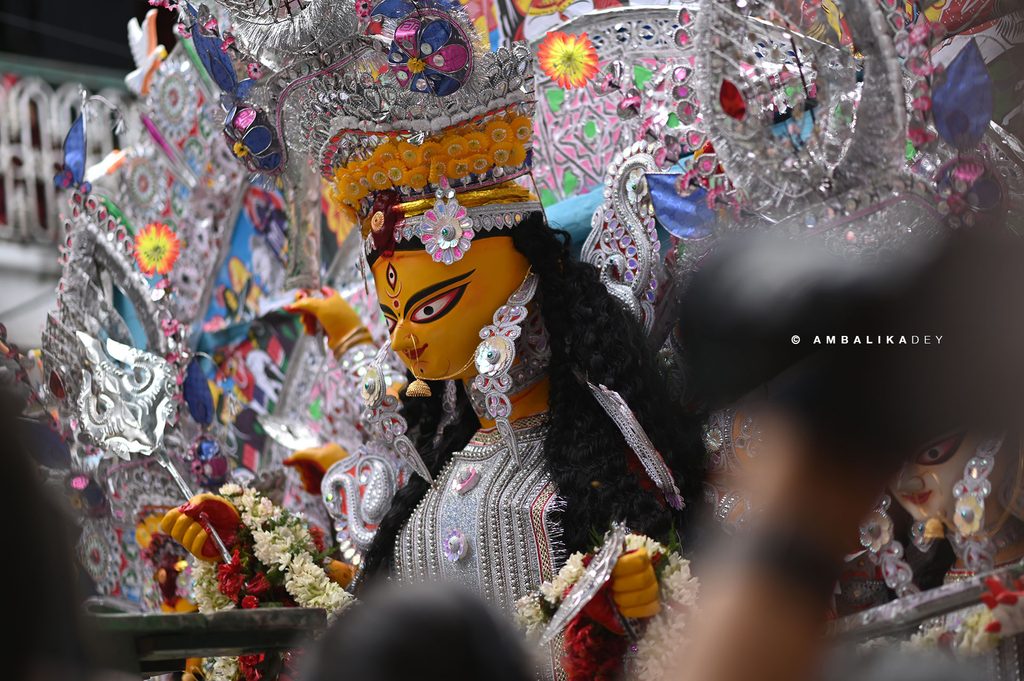
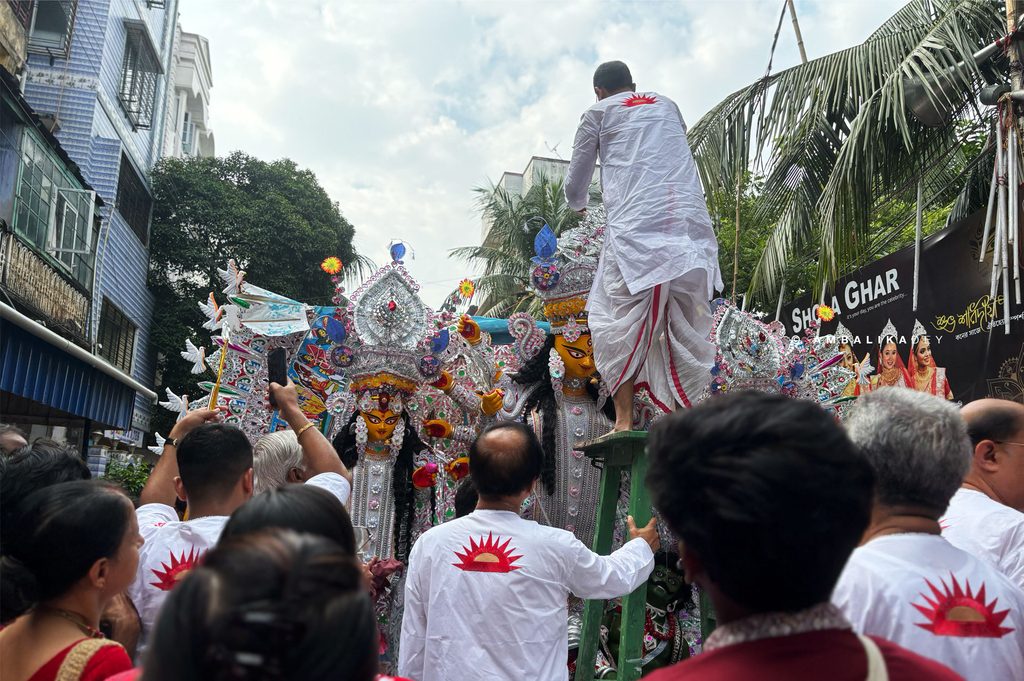
Their idol is moderate in scale, but immense in presence.
What amazed me was how meticulously they maintained an elegant, clean and graceful image of the Goddess throughout the Dashami rituals. Every member of the family appeared in coordinated attire. The men wore similar kurtas bearing their embroidered emblem of a half-risen sun, while the women wore matching badges draped from the shoulder. There was a sense of humility, order and quiet dignity in the way everyone carried themselves.
Even the application of vermilion reflected that restraint. The sindoor was placed carefully upon the centre of the Goddess’s crown, never across the face. Her serene expression remained untouched until the very end. The Goddess, along with her four children, was then lifted manually using four long bamboo poles and carried on foot through North Kolkata’s historic lanes to Baghbazar Ghat, a journey of nearly two kilometres towards the Ganges.
From the neighbourhood to the ghat, an unbroken stream of people followed.
Children, teenagers, adults, the middle-aged and the elderly. People from every walk of life moved along with the rhythm of the idol bearers. The entire stretch of the Baghbazar-Kumartuli Road seemed united by a single purpose: catching a few more glimpses of the Goddess in her final moments among us.
Legs tired from walking. Arms tired from holding cameras aloft. Yet nobody seemed willing to stop.
Reaching the ghat and awaiting the immersion became a spectacle in itself. The rest, as they say, is history.
Thankfully, I was able to document parts of this journey on video and photographs, preserving a few fragments of a tradition that has endured for generations.
Shobha Bajar Rajbari’s Chhoto Taraf orchestrated this farewell with remarkable grace, safety and devotion, all at once. Amidst it all, I noticed something quietly beautiful. While we waited at the ghat for the final immersion, the male members of the family had already boarded the barge, dressed in safety jackets for the journey to the middle of the river. Meanwhile, the female members remained on the ghat, dancing, celebrating and cherishing the joy of the moment even as the farewell drew near. It was a striking contrast, one that seemed to capture how life often balances celebration and separation in the very same moment.
Having witnessed these Bijoya rituals for the first time in my 40 years, I can honestly say that they have made Durga Puja 2026 my most well-rounded Puja experience yet.
Somehow, I feel a little more connected to the City of Joy.
A little more connected to its heritage.
And a little more Bengali.
Shubho Bijoya Doshomi.
0 Comments